

FOR IMMEDIATE RELEASE
Truth Commission Looks Beyond the Streets for ‘Drug War’s’ Hidden Dead
Senator Risa Hontiveros and Justice Secretary Fredderick Vida to speak at commission’s national conference on Monday.
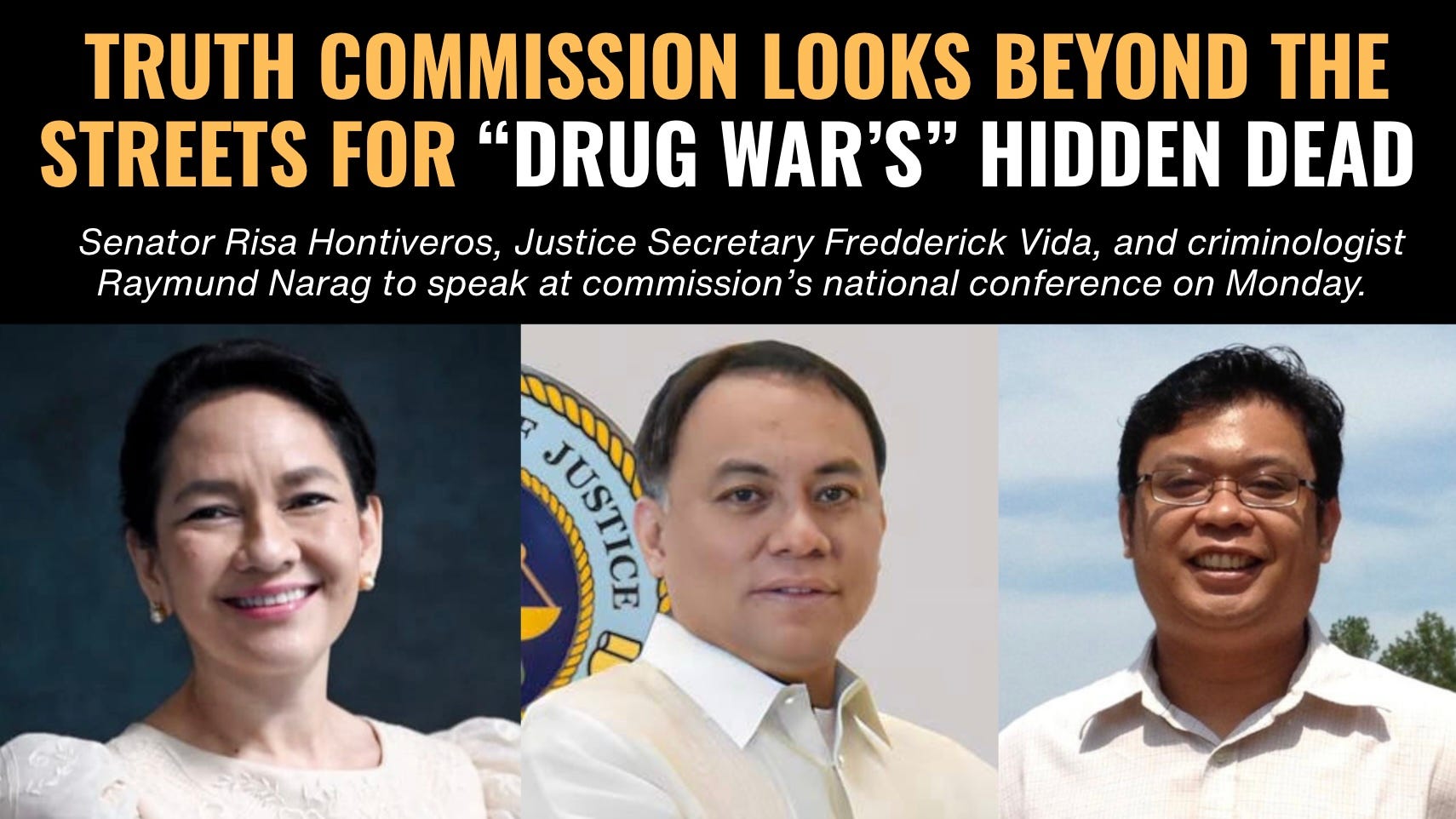
MANILA, Nov. 22 — Senator Risa Hontiveros and Justice Secretary Fredderick Vida will join scholars and lawyers in Manila on Monday at the first national conference of the Truth Commission, a citizen-led body documenting killings in former President Rodrigo Duterte’s “drug war.”
Hontiveros will deliver the welcome remarks at the event while Vida will serve as a reactor to the commission’s report.
The commission, formed in May and chaired by Raul Pangalangan, a former ICC judge, will present a six-month report on its work. Its afternoon panels push the debate past the bodies left on city streets. They look at the jails where detainees died out of sight and at the police who carried out the crackdown.
Dr. Raymund Narag, a criminologist at Southern Illinois University Carbondale, will present a paper on what he calls “judicial killings.” These are deaths that happened inside the justice system rather than in police raids, among detainees held in packed cells while their cases crawled through the courts. His study runs from 2016 to 2025, three years past the end of Duterte’s term.
The subject is personal. Dr. Narag spent six years, nine months and four days in the Quezon City Jail before a court acquitted him, his university says. In earlier writing, he found that mass arrests had made the country’s jails the most crowded in the world. He also found that more than 70 percent of people held in jails and prisons had been arrested on drug charges, and that about 95 percent of drug offenders were charged with having less than 0.01 grams of methamphetamine or shabu. He wants deaths in custody counted as part of the campaign’s human cost rather than filed away as ordinary deaths.
Two psychologists from Ateneo de Manila University, Dr. Cristina Jayme Montiel and Dr. Joshua Uyheng, will share his panel. Their paper asks why so many Filipinos backed the “drug war” despite the killings. Their earlier research traced part of that support to promises of safer neighborhoods. Dr. Montiel also co-wrote a study finding that ordinary supporters, not only officials, justified the violence through the way they talked about it. The lawyer Bayan Joseph Quinones will chair the session.
A second panel turns to the police. Dr. Enrico Antonio B. La Viña, a political scientist at the University of the Philippines Diliman, will examine whether officers rose through the ranks from 2016 to 2023. Dr. La Viña’s earlier work found that Senate candidates who backed the crackdown in 2019 did better where drug crime was common but worse in places where the police had killed suspects.
Father Albert E. Alejo, a Jesuit priest now at the Pontifical Gregorian University in Rome, will speak on confessions by former members of the Davao Death Squad. The group is accused of killing suspected criminals in Davao City when Duterte was mayor. Father Alejo ministered to Edgar Matobato, who told the Senate in 2016 that he had been a hitman for 24 years in a squad he said was formed under Duterte. Duterte has denied the claim. After a screening of “Tirik,” a film about a priest and a taxi driver haunted by his past who flee an attempt on their lives, Father Alejo will help lead the discussion.
Silvestre Acedillo of the Roundtable Consortium will take up a tension the commission faces: how to name wrongdoing without acting as a court. The commission has said it will not assign criminal guilt but will recommend reforms. The lawyer Mario Maderazo will chair that panel.
A third panel asks what justice will mean for families and who will pay for their losses. Sabrina Ochoa, a fellow at the Institute of Current World Affairs who covers the case from Manila and The Hague, will describe the work of connecting Filipino families with a court thousands of miles away. Victims may take part in the proceedings through their own lawyers, who say many families have faced harassment from Duterte’s supporters.
Raniel Lorenzo of the Polytechnic University of the Philippines College of Law will argue that the government’s cooperation is essential, because the court can order payments to victims only after a conviction. The Philippines left the court in 2019, but it surrendered Duterte to The Hague in March 2025. Advocates have long pressed for a national law to compensate victims, similar to the 2013 law for victims of martial law.
Yeo Gyeong-Su of the 10.19 Research Institute at Sunchon National University in South Korea will offer a view from abroad. His institute studies the mass killings of civilians that followed a 1948 army revolt in the southern cities of Yeosu and Suncheon. Families there waited 73 years for a special law to investigate the deaths and clear the victims’ names. A regional committee finished reviewing 2,610 reports only this September, and hundreds more are still pending.
For Filipino advocates, the Korean case is both a model and a warning. Such efforts can succeed, but they can take generations and depend heavily on government support.
The conference at a glance
What: “From Truth to Justice: Honoring Victims, Advancing Accountability,” the first national conference of the Truth Commission.
When: Monday, Nov. 23, 8 a.m. to 5:30 p.m.
Where: Philippine Normal University, 104 Taft Avenue corner Ayala Boulevard, Ermita, Manila.