

PRESS RELEASE
These Journalists Covered the 'Drug War.' Here’s Why Their Work Is Important.
A decade after Duterte’s “drug war” began, journalists who covered the killings will weigh whether their work can help hold someone to account, a week before his trial opens in The Hague.
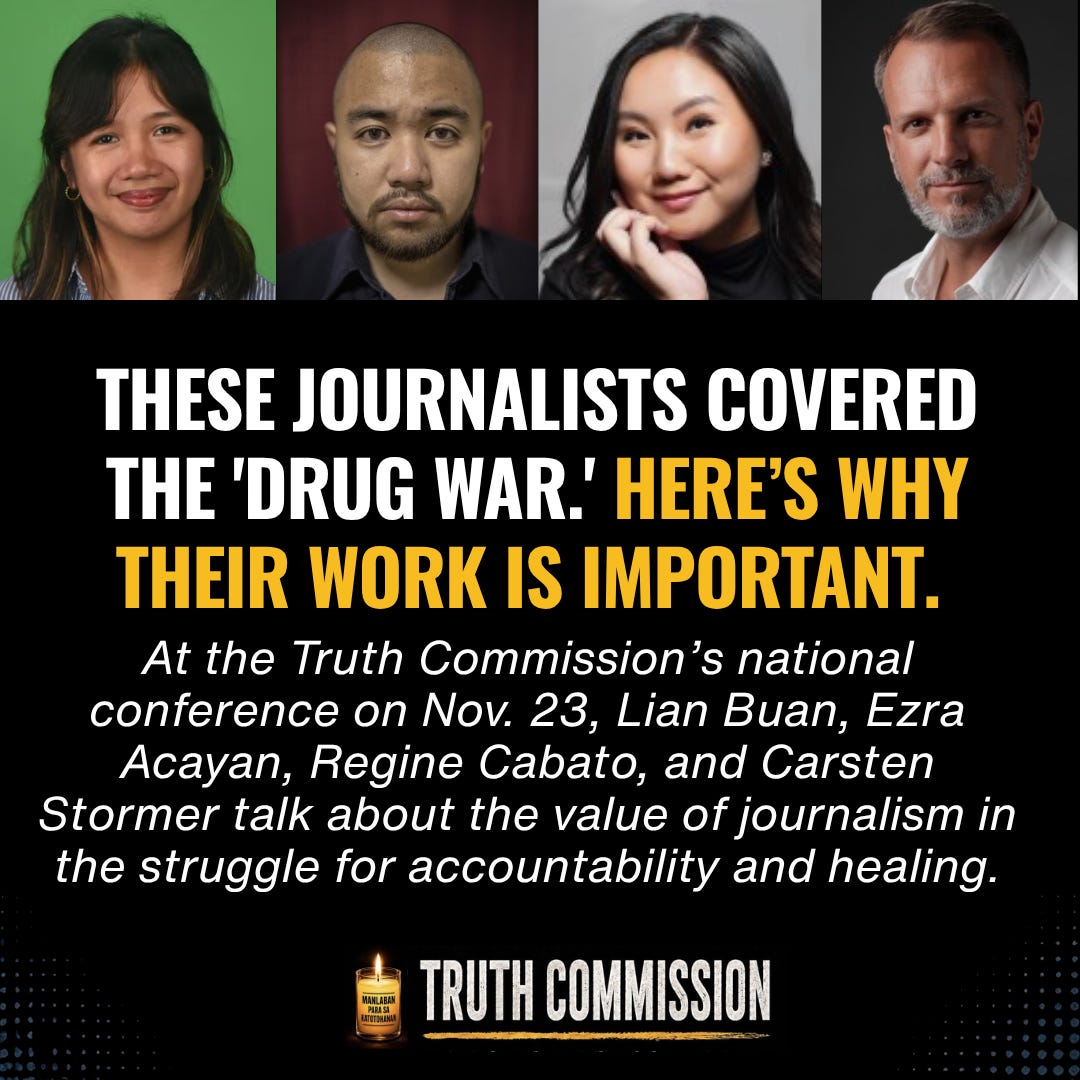
MANILA, Nov. 21, 2026 — More than 10 years after the “drug war” killings under the Duterte administration, four journalists who covered them will gather on Monday to discuss whether their notebooks and photographs can help establish what happened, and who should answer for it.
The panel, "Bearing Witness to the 'Drug War': Journalists' Accounts, Evidence, and the Pursuit of Truth," is part of the first conference of the Philippine Truth Commission, a citizen-led body formed in May to build a public record of the killings under former President Rodrigo Duterte.
The speakers covered the campaign from different angles. Lian Buan, then an investigative reporter for Rappler and now a researcher at Human Rights Watch, has written extensively about the killings and about the proceedings against Duterte at the International Criminal Court. Regine Cabato, who reported for The Washington Post, covered the killings and their effect on families and neighborhoods.
Ezra Acayan, an award-winning Filipino photojournalist, documented the victims and the relatives they left behind. Carsten Stormer, a German reporter and documentary filmmaker, has also chronicled what the crackdown did to families. The panel will be moderated by Carlos Conde, who documented the "drug war" as a senior researcher for Human Rights Watch and is now a member of the commission.
The session sits within a track on "Documentation, Data, and Media Coverage," and its title signals the aim: to weigh how journalists' accounts can serve as evidence. That question has grown more pressing as the case against Duterte heads to trial in The Hague on Nov. 30 and as victims' families press for accountability at home. When the trial opens, lawyers for the victims will give opening statements right after the prosecution.
In the early years, news reports were one of the few independent records of the dead. When police figures were disputed, newsrooms and university researchers kept their own tallies, each with its own method. Some of those efforts continue. The Dahas Project of the University of the Philippines' Third World Studies Center, which draws mostly on local and provincial news reports, logged 269 drug-related killings in 2025, even as the current government describes its approach as bloodless.
The panelists are expected to reflect on what they saw firsthand and on how their records hold up against official accounts that often described the dead as suspects who fought back, or nanlaban. For families, such accounts may also confirm details that official records left out or got wrong.
The session also touches on a second concern that runs through the conference: disinformation and online attacks. Victims who have come forward in the International Criminal Court case have faced harassment online and in person from Duterte supporters, according to their lawyers, and disinformation about the case can keep victims from getting accurate information.
For the reporters, the panel is a chance to turn years of daily coverage into something more lasting. Many of the stories they told were about one family or one night. Placed side by side with forensic findings and testimony gathered by the commission, those accounts could help fill gaps in a public record that remains incomplete, with no agreed count of how many people died.
The breakout session, which will be livestreamed on the Truth Commission’s social media accounts, follows a morning session in which relatives of victims, called "truth tellers" by the commission, will reflect on their experiences since they first shared their stories in public. Since August, the commission has held regular truth-telling public sessions where families recount the deaths of their loved ones. It has so far recorded 8,320 deaths in the “drug war.”
The 1st Truth Commission National Conference at a glance:
What: "From Truth to Justice: Honoring Victims, Advancing Accountability," the first conference of the Truth Commission.
When: Monday, Nov. 23, 2026, 8 a.m. to 5:30 p.m.
Where: Philippine Normal University, Taft Avenue corner Ayala Boulevard, Ermita, Manila.