

FOR IMMEDIATE RELEASE
1ST TRUTH COMMISSION NATIONAL CONFERENCE
Caregivers and Researchers to Share What Survivors of the ‘Drug War’ Still Need
Years after the killings, the people left behind still need help with grief and with a society that often blames them for their loss. At a conference in Manila on Monday, the people who walk with those families will describe what that work demands.
Three panels at the first conference of the Truth Commission, all part of a track on victims, survivors, families and communities, will take up their work. The commission, a citizen-led body formed in May, is documenting killings carried out during former President Rodrigo Duterte’s “drug war.” The conference will be held at Philippine Normal University.
The first panel, “Walking with Survivors: Stories of Care, Healing, and Solidarity,” brings together four care providers. Sister May Cano of Caritas in the Diocese of Kalookan, Milet Mendoza of the group SIBOL, Rebecca Karen Tanada of the women’s group Baigani and Father Flavie Villanueva of Program Paghilom will draw on their work with widows and orphans.
They will talk about earning the trust of families who have reason to fear outsiders and about meeting grief alongside everyday needs as relatives pursue justice. The panel will also highlight the leadership of survivors themselves, many of whom now help other families.
Their groups have done this work for years. Baigani was set up to bring together widows and mothers who were cut off from their own communities, and with church partners it has offered them free therapy and legal help. Father Villanueva has spoken about the stigma these families face, telling Agence France-Presse that orphans were bullied at school and widows shut out of government aid. Research on widows of the “drug war” has found that many were stigmatized after their husbands were killed.
A second panel, “Human Rights in Everyday Lives: Community Knowledge, Research, and Action,” will be chaired by Dr. Mary Racelis, a social anthropologist at Ateneo de Manila University and the University of the Philippines. Dr. Racelis has spent decades studying poor urban communities and is known for research done with residents rather than about them.
Her panel will pair community leaders with academic researchers to examine how neighborhoods view drug use, how treating drug use as a crime has affected them, and how families have responded to the killings on their own. Drawing on interviews and local research, the panelists hope to show how this kind of joint work can give communities a stronger voice in the search for truth and lead to concrete action.
A third panel, conducted in Filipino, will take up the role of faith. Titled “Pakikibaka at Pananampalataya: Saan ang Diyos sa Panahon ng Pagsubok” (”Struggle and Faith: Where Is God in Times of Trial”), it will look at how belief has shaped the lives of victims’ families as they seek justice together with other families and the groups that helped them. Its panelists had not been confirmed when the program was released.
The church has been central to that support. As early as 2017, it had become a growing source of support for relatives of the dead, offering both money and comfort.
The afternoon panels build on a morning program centered on the families. Twelve relatives of victims, whom the commission calls “truth tellers,” will reflect on their experiences since first speaking in public, while young people from Program Paghilom will stage a play about families affected by the killings.
Taken together, the sessions are meant to make the case that justice for the families is not only a matter for courts. It also depends on whether those who survived can rebuild their lives.
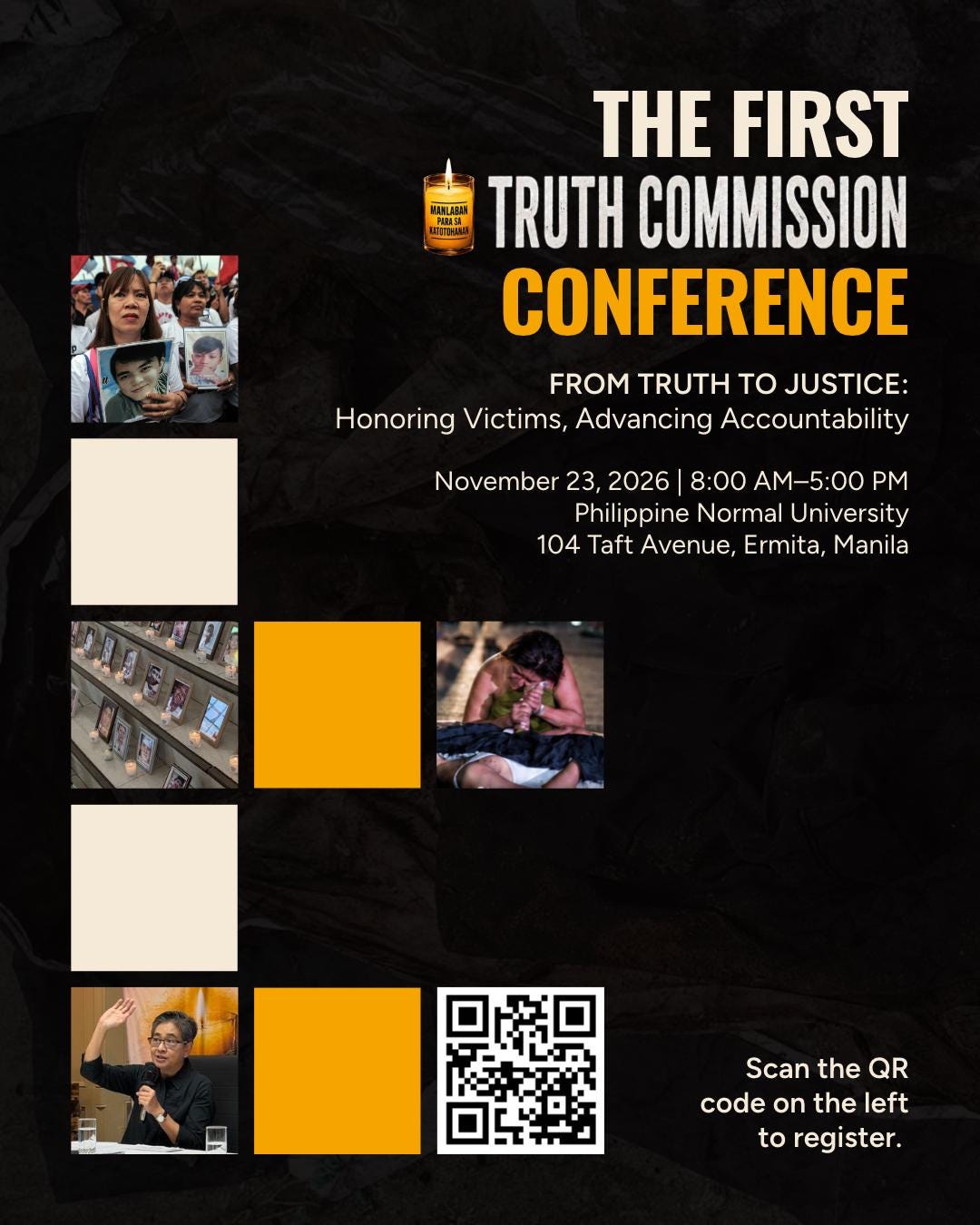
The 1st Truth Commission National Conference at a glance:
What: “From Truth to Justice: Honoring Victims, Advancing Accountability,” the first conference of the Truth Commission.
When: Monday, Nov. 23, 2026, 8 a.m. to 5:30 p.m.
Where: Philippine Normal University, 104 Taft Avenue corner Ayala Boulevard, Ermita, Manila.